For decades, business software has largely been built around one core function, accounting.
Solutions like Tally, Busy Accounting Software, and QuickBooks have played a critical role in helping businesses maintain financial records and stay compliant.
And for a long time, that was enough.
But as businesses grow, operations become more interconnected, and expectations from software begin to shift. Today, businesses are not just looking for tools that record transactions, but systems that offer visibility, reduce operational complexity, and support faster decision-making.
This shift has also led many businesses to actively explore Tally alternatives for small business, Zoho Books alternatives India, and Busy accounting software alternatives that can go beyond basic accounting.
The Shift: From Tools to Systems
As businesses scale, they begin managing multiple functions simultaneously:
- Sales and billing
- Inventory across locations
- Banking and reconciliation
- Reporting and performance tracking
In many cases, these functions are handled using separate tools or loosely connected systems.
While this setup may work initially, over time it often results in:
- Fragmented data across platforms
- Delayed insights
- Increased manual effort
- Limited visibility across operations
This is where the shift becomes evident.
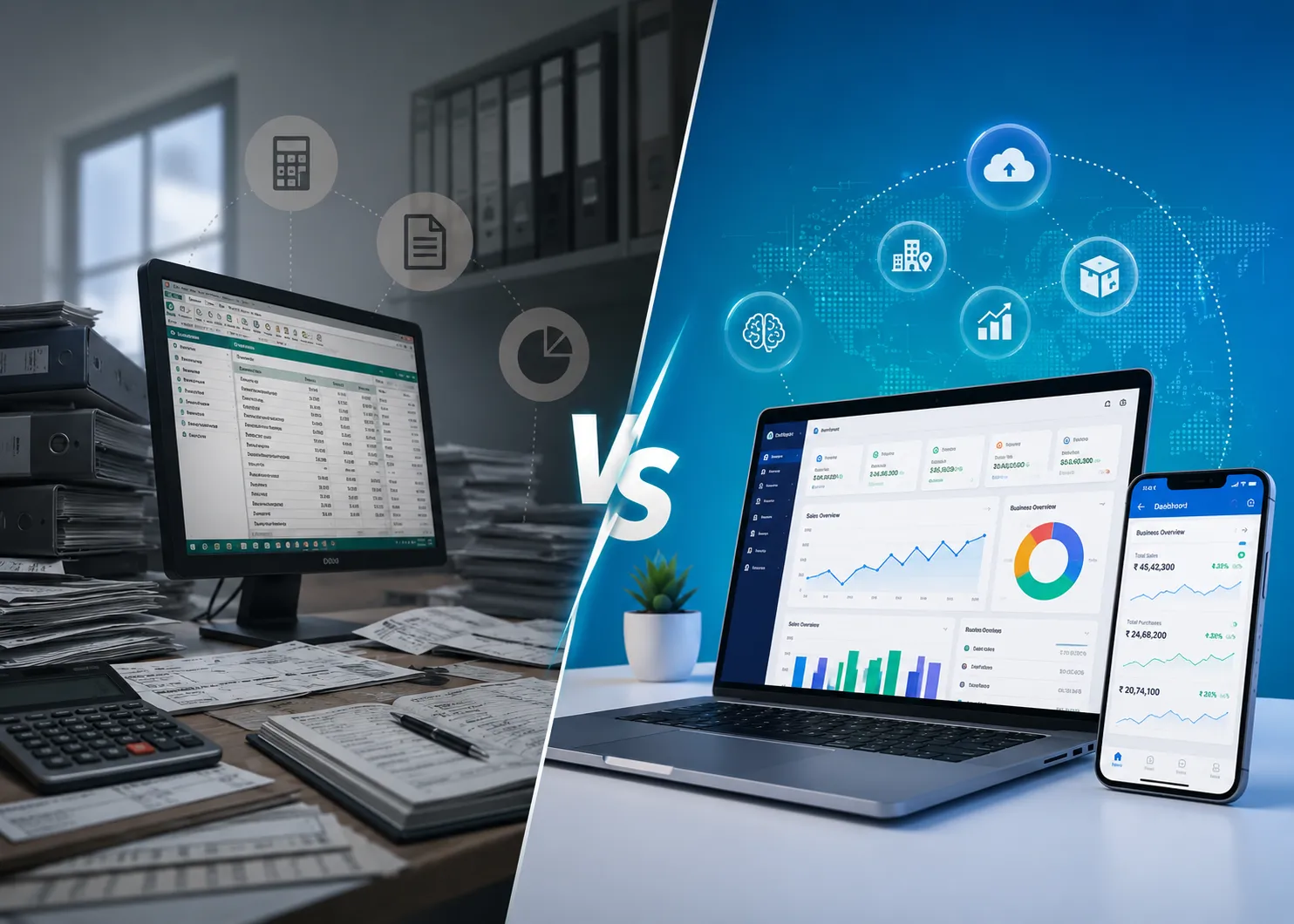
Businesses are gradually moving from standalone tools to integrated business systems like cloud ERP for MSMEs, where operations, accounting, and reporting are connected in one place.
Ankpal is built around this approach.
Understanding the Current Software Landscape
Most solutions available today fall into three broad categories:
1. Legacy Desktop Software
- Tally
- Busy Accounting Software
Reliable for accounting and compliance, but often dependent on servers, manual setups, and limited scalability.
Even with solutions like Tally cloud hosting, many businesses still rely on external infrastructure and fragmented workflows.
This is why comparisons like Ankpal vs Tally are becoming more relevant as businesses evaluate modern needs versus traditional systems.
2. Cloud Accounting Tools
- Zoho Books
- QuickBooks
Offer better accessibility and usability, but remain largely focused on accounting, with limited operational depth.
As a result, many growing businesses now actively look for Zoho Books alternatives India that provide broader workflow coverage.
3. Point Solutions
Standalone tools built for specific functions like billing or invoicing.
While effective in isolation, they often increase complexity when combined with multiple systems.
What Ankpal Offers
Ankpal approaches this differently, not as an accounting tool with added features, but as a connected business system.
In simple words:
Ankpal = Vyapar + Tally/Busy + Zoho + Biz Analyst that too with AI in addition
It combines:
- Billing and invoicing
- Accounting and compliance
- Inventory and order management
- Multi-location and multi-company operations
- Centralized reporting and analytics
This makes it not just an accounting solution, but a complete accounting software with inventory management and operational control.
It also functions as a powerful multi location inventory management software, enabling businesses to track stock across branches in real time.
All within a cloud-native architecture, enabling real-time access without infrastructure dependency, a key advantage of modern cloud ERP for MSMEs.
The result is a system where data flows seamlessly across functions, reducing duplication and improving efficiency
Adding Intelligence with AI
Traditional systems are designed to record transactions and generate reports.
Ankpal extends this by introducing AI-driven insights, positioning itself as a business software with AI insights.
This enables businesses to:
- Understand performance in real time
- Identify trends and patterns
- Reduce manual reporting effort
- Make faster, data-backed decisions
Rather than being a separate feature, AI acts as a layer that enhances everyday business operations.
Feature Comparison: Ankpal vs Other Software
| Feature | Ankpal | Tally | Zoho Books | Busy Accounting Software | |
| Core Approach | Integrated business system | Accounting-first | Accounting-first | Accounting + inventory | |
| Cloud Architecture | Native cloud | Server hosted | Cloud-based | Server hosted | |
| Multi-location Support | Built-in | Limited | Limited | Partial | |
| Inventory Management | Advanced | Basic | Basic | Strong | |
| Workflow Coverage | End-to-end | Limited | Limited | Limited | Limited |
| AI-Powered Insights | Included | Not available | Not available | Limited | Not available |
| Ease of Use | Modern, intuitive with 100% Keyboard | Learning curve | User-friendly | User-friendly | Moderate |
This comparison clearly highlights why discussions like Ankpal vs Tally are increasing among growing MSMEs.
Understanding the True Cost of Business Software
When evaluating software, the focus is often placed on license pricing.
However, the actual cost of using a system extends far beyond that.
Over time, businesses incur additional expenses in the form of:
- Infrastructure and server setup
- IT maintenance and support
- Third-party tools to fill functional gaps
- Manual effort for compliance and reporting
This is where the concept of total cost of ownership becomes critical.
Ankpal, being a cloud native GST filing software for small businesses, eliminates dependency on external tools and reduces long term operational costs.
| Feature | Ankpal | ZohoBooks | Tally | Busy | Marg |
| Starting Prices | 400/Month | 750/Month | 8100/Year | 9,999/Year | 10300/Year |
| Cloud-Based | Yes | Yes | Server Base | Server Base | No |
| Additional Server Access Cost | No | No | 600/Month | 600/Month | 600/Month |
| Total Cost | 4,800 | 8000 | 15,300/- | 17,200/- | 17,500 |
| Target Industries | MSMEs, SMEs, Pharma, FMCG, Electronics, Garment, Online Seller | SMEs & Startups | Only Accounting | FMCG & Electronics | Pharma |
| Mobile Application | Yes | Yes | Third Party | Yes | Yes |
| AI Features | Yes | No | No | No | No |
| Multi-User | Yes | Yes | Yes | Yes | Yes |
| Multi-Company | Yes | No | Yes | Yes | Yes |
| Branch-wise Inventory | Yes | No | No | Yes | Yes |
| Multi Location | Yes | No | No | No | No |
| Rack & Bin Wise | Yes | No | No | No | No |
| Order Processing | Yes | No | Yes | Yes | Yes |
| Approvals | No | Yes | No | No | No |
| Roles Permission | Yes | Yes | Yes | Yes | Yes |
| Email / SMS Notification | Yes | Yes | Yes | Yes | Yes |
| Dashboard MIS | Yes | Yes | Yes | Yes | Yes |
| Multi-Currency | Yes | Yes | Yes | Yes | Yes |
| Excel Import | Yes | Yes | Yes | Yes | Yes |
| GST Filing | Yes | No | Yes | Yes | Yes |
| TDS Report | No | No | Yes | Yes | Yes |
| GST Reconciliation | Yes | No | Yes | Yes | Yes |
| Bank Reconciliation | Yes | Yes | Yes | Yes | Yes |
| Payment Gateway | No | Yes | No | Yes | Yes |
| Sales Agent | No | No | No | No | No |
| Customer & Vendor Dashboard | Yes | Yes | No | No | Yes |
| Auditor Appointment | Yes | No | Yes | Yes | No |
| Asset Management | Yes | No | Yes | Yes | Yes |
| Payroll Accounting | Yes | Yes | Yes | No | Yes |
While the differences are clear on paper, the real impact becomes visible in day to day business operations.
What This Means in Practice
Rather than evaluating software purely on upfront pricing, it becomes important to consider:
- How many systems it replaces
- How much manual work it eliminates
- How efficiently it supports operations
A platform that simplifies workflows and reduces dependencies often delivers greater long-term value.
Implementation: From Setup to Adoption
Choosing software is not just about features, it’s also about how quickly and effectively it can be implemented.
Typical Implementation Experience
| Factor | Ankpal | Traditional Systems | Cloud Tools |
| Implementation Time | 10–15 Days | 1–2 Weeks | 8–12+ Weeks |
| Infrastructure Setup | Not Required | Required | Not Required |
| Data Migration | Excel-based | Manual | Assisted |
| Training Time | 2–3 Days | 2–3 Days | 15–30 Days |
| Go-live Complexity | Low | Low | High |
Why Implementation Matters
A smoother onboarding process leads to:
- Faster time to value
- Lower disruption to daily operations
- Easier adoption across teams
For growing businesses, this directly impacts how quickly they can transition and start seeing results.
When Do Businesses Consider Switching?
Typically, businesses begin exploring alternatives when:
- Operations expand across locations
- Multiple tools create inefficiencies
- Real-time visibility becomes essential
- Manual processes slow down decision-making
At this stage, moving to a unified system becomes a practical step toward improving efficiency and control.
Final Thoughts
Business software is evolving, from standalone tools to connected, intelligent systems.
While traditional solutions continue to serve specific needs, the broader shift is toward platforms that offer:
- Integration across functions
- Cloud-based accessibility
- Real-time visibility
- Data-driven insights
Ankpal aligns with this evolution by bringing together operations, visibility, and intelligence into a single system, enabling businesses to move forward with greater clarity and control.